
An honest look at bioinformatics careers in the age of AI, from someone who just lived through the job market
Lately my feeds have been full of funerals.
Not real ones. Career ones. Scroll through LinkedIn, Reddit, or any grad-student forum and you’ll find the same eulogy written a hundred different ways: Bioinformatics is dead. Only a fool would study it now. AI does everything. The posts usually come with a story attached. Someone with a master’s or a PhD sent out applications for a full year. Hundreds of them. Silence. Not even a rejection email. And the conclusion they draw is always the same: AI replaced us, and the field is finished.
I want to be careful here, because the pain in those posts is real. I’m not going to wave it away. But the conclusion? I couldn’t disagree more.
I’ve spent more than ten years building NGS analysis pipelines, training researchers to use them, and running ngs101.com to teach the stuff graduate programs often skip. I’ve also, very recently, been on the wrong end of a brutal job search myself. So let me tell you what I think is actually happening: what’s real, what’s panic, and what you can do about it.
Is Bioinformatics Dead? The Viral Claim Taking Over My Feed
Here’s the argument in its purest form. AI can now write code, run analyses, and summarize papers. Bioinformaticians write code, run analyses, and summarize results. Therefore bioinformaticians are obsolete. QED.
It sounds airtight until you notice that it describes a bioinformatician as a person who types commands. That’s like describing a surgeon as a person who holds a knife.
Before I take that argument apart, though, I want to zoom out. The most useful thing I can tell you about the “bioinformatics is dead” panic is that it isn’t new. Not even a little.
We’ve Read This Obituary Before: A Short History of Technology Panic

In 1839, when the French painter Paul Delaroche first saw a daguerreotype, he reportedly declared: “From today, painting is dead.”
Painting, as you may have noticed, is not dead. What died was the idea that a painter’s main job was to copy reality as precisely as possible. Photography took that job, and painters responded by inventing Impressionism, Expressionism, abstraction, and pretty much every movement you’d see in a modern art museum. The camera didn’t kill the artist. It killed the photocopier version of the artist.
Now swap in any technology you like and you’ll find the same headline:
- Computers were going to replace human thinking. Newspapers in the 1950s called them “electronic brains,” and plenty of people assumed the human kind would soon be redundant.
- Television was going to rot minds and destroy society. In 1961, the chairman of the FCC famously called TV programming “a vast wasteland.”
- Automation and robotics were going to take all the jobs. In 1964, a group of prominent intellectuals sent President Johnson a memo warning that “cybernation” would create mass, permanent unemployment.
- The internet was going to destroy privacy, safety, and human relationships.
- And now AI has supposedly replaced software engineers and bioinformaticians. Computer science is dead. Bioinformatics is dead.
So let me ask you a few questions, and I want you to answer honestly.
Have computers replaced human thinking in the eighty-odd years since we built them? Did robots take all the jobs? Did Microsoft Excel replace accountants?
That last one is my favorite, because we actually have the data. When VisiCalc, the first spreadsheet program, arrived in 1979, the arithmetic that made up much of an accountant’s visible work suddenly took seconds. In the decades since, hundreds of thousands of bookkeeping and accounting clerk jobs disappeared in the US. Over the same period, the number of accountants grew by even more. The spreadsheet killed the tedious task and multiplied the people who knew what the numbers meant.
The same thing happened with ATMs. Economist James Bessen dug into the numbers and found that ATMs did exactly what pessimists predicted at the branch level: a typical branch needed fewer tellers. But because branches became cheaper to run, banks opened many more of them, and total teller employment held steady and even grew for decades while ATMs spread across the country. The tellers who stopped counting cash and started managing customer relationships did just fine.
Did cameras replace artists? Did spreadsheets replace accountants?
Now ask yourself the same question about AI. Will it make human effort meaningless? Will it take most of the jobs? Will it replace human creativity?
Be honest.
The Five Stages Every New Technology Goes Through
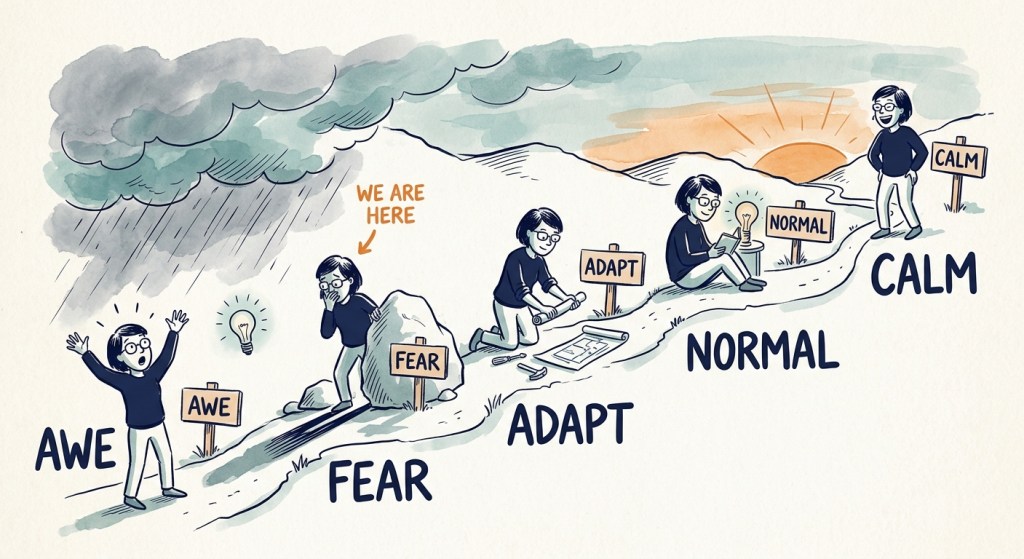
Once you’ve seen enough of these cycles, you start to notice that they all follow the same emotional script. It goes something like this:
- Awe: “This is incredible.”
- Fear: “This will destroy jobs, minds, morality, or humanity.”
- Adaptation: “We need rules, norms, and skills.”
- Integration: “This is normal now.”
- Retrospective calm: “Why were we so scared?”
Nobody today lies awake worrying that the calculator will make mathematicians obsolete. Nobody thinks Google Maps is a threat to human civilization (well, almost nobody). Every one of those technologies passed through the fear stage and came out the other side as boring infrastructure.
Where is bioinformatics right now? I’d say we’re stuck squarely between stage two and stage three. The awe phase was 2023. The first time most of us watched a chatbot write a working R script, it felt like magic. Now we’re in the fear phase, and the “bioinformatics is dead” posts are its loudest symptom.
Here’s what I want you to take away from this: the people who come out ahead are always the ones who move to stage three first. Adaptation isn’t a consolation prize. It’s the whole game.
The Lab Test: Can AI Actually Run Your Research Project?

Let’s make this concrete. Forget abstract debates about artificial general intelligence. Let’s run a simple test in the place where most bioinformaticians actually work: a research lab.
Imagine you’re a biologist and your PI calls you into their office with a new project. Let’s say it’s figuring out why a subset of patients stops responding to a therapy. Here’s what that project actually requires:
- A plan tailored to this lab’s samples, budget, timeline, and existing data.
- Meaningful biological questions. Not “what genes are differentially expressed?” but “which cell population is driving resistance, and why only in some patients?”
- A hypothesis that’s specific enough to be wrong.
- An experimental design that can actually test it: sample sizes, controls, batch structure, which sequencing assay, which time points.
- Data collection, which involves real tissue, real reagents, and real mistakes at the bench.
- Analysis, from QC and alignment to normalization and modeling, with dozens of judgment calls along the way.
- Interpretation. Does this result make biological sense, or is it an artifact?
- Communication, which means presenting to skeptical colleagues, defending choices at lab meeting, surviving Reviewer 2, and publishing.
Now go back through that list and ask: which of these can AI do by itself, start to finish, with no one who understands the biology in the loop?
AI can help with nearly every step. It can suggest a design, draft the analysis code, summarize the literature, even polish your figure legends. That’s genuinely valuable. But it can’t sit in your PI’s office and understand why this project matters to this lab right now. It doesn’t know that your samples came from two hospitals with different freezing protocols. It doesn’t know that the “top hit” in your differential expression results is a known contaminant in your core facility’s library prep. It can’t feel the small alarm bell that goes off when a cluster in your single-cell data looks too clean to be real.
And it can’t be accountable. When a reviewer asks why you chose that normalization method, “the AI picked it” isn’t an answer anyone will accept.
The project needs a scientist. AI makes that scientist faster. It doesn’t make them optional.
“Then Why Can’t I Find a Job?” The Honest Answer About the Bioinformatics Job Market
This is where a lot of people push back, and fairly so. If AI isn’t replacing us, why can’t I get a single interview with a master’s degree, or even a PhD, in bioinformatics?
That question deserves a real answer, not a pep talk. So let me start with my own story.
My Own 100-Application Year

Last year, I applied to more than 100 positions. I have over a decade of experience in bioinformatics, a publication record in top journals, and years of hands-on pipeline development across sequencing technologies. I got five interviews.
Five.
A few years ago, five was roughly the number of offers I’d receive in a job search. So when I read posts from people who sent hundreds of applications into the void, I don’t think they’re exaggerating or lazy. I’ve lived a version of it.
But when I looked honestly at why that search was so hard, AI was not at the top of the list. It was part of the picture, and I’m not going to pretend otherwise, but it wasn’t the main character. Let me show you what the market actually looks like.
What the Bioinformatics Job Market Data Actually Says in 2026

If bioinformatics were dead, you’d expect the job boards to look like a ghost town. They don’t.
CompBioJobs, a board that tracks computational biology and bioinformatics postings, counted 1,684 distinct postings from 247 companies in just the third quarter of 2026. They’re careful to point out that their numbers reflect their own coverage, not the entire industry, so the real market is bigger. The biggest posters were exactly who you’d expect: Amgen, AstraZeneca, Johnson & Johnson, Merck, and Genentech. Behind them was a long tail of smaller biotechs, startups, and academic centers, with roughly half the companies posting just a single role.
Now look at what those postings are asking for:
- About 44% were AI/ML roles, either with AI or machine learning in the title or with concrete AI/ML skills in the job description.
- At the scientist/mid-level, AI/ML roles advertised starting salaries about 21% higher than other roles at the same level.
- Venture-backed startups leaned even harder into AI, with nearly 60% of their computational roles involving AI/ML.
- The highest-paying postings that quarter included life-science roles at AI companies like the OpenAI Foundation and Anthropic, alongside big pharma.
Read that again. The companies building AI are hiring people who understand biology. The market isn’t telling you that AI replaced bioinformaticians. It’s telling you that bioinformaticians who can work with AI are among the most sought-after people in the life sciences.
The same data also shows something that explains a lot of the pain. Roughly 65% of postings were senior, principal, director, or executive level. Internships, entry-level roles, and postdocs together made up only about 13%.
That’s the real story. The market isn’t dead. It’s top-heavy. It’s hungry for experienced people who can own an analysis end to end, and it has very little patience for training beginners. If you’re early in your career, you’re competing for a much smaller slice of the pie, and that slice is crowded.
The Real Reasons the Bioinformatics Job Market Feels Brutal
So if it’s not simply “AI took the jobs,” what’s going on? From where I sit, at least five forces are stacking on top of each other.
1. The biotech funding winter. After the pandemic boom, money dried up. Biopharma layoffs climbed sharply in 2025, and industry analysts pointed to capital tightening (a closed IPO window and pressure on public biotechs) as the main driver. AI, by their account, played a secondary and indirect role. When a startup loses its runway, the bioinformatics team gets cut along with everyone else. That’s a funding story, not a robot story.
2. Academic funding shocks. In early 2025, NIH grant processing was frozen for months and major universities announced hiring freezes. Some labs had to rescind offers to postdocs they had already recruited. Even after funding was largely restored, many institutions stayed cautious. Academia has always been a major employer of bioinformaticians, and for a stretch, that door was barely open.
3. A squeeze at the bottom of the ladder. As the CompBioJobs data shows, employers are mostly hiring experienced people. This is where AI genuinely does play a role. The simplest, most routine tasks, the kind that used to be handed to a junior analyst to learn on, are now faster to do with AI assistance. That makes the entry-level rung narrower. It doesn’t make the ladder disappear.
4. Everyone can apply to everything. Remote postings, one-click applications, and AI-written cover letters mean a single opening can be buried under an avalanche of applications. I suspect a lot of the “hundreds of applications, zero replies” experience comes from this. Your application isn’t being rejected. It’s being drowned.
5. The curriculum can’t keep up with the field. This is the one I care about most, because it’s the one you can actually fix.
Bioinformatics moves so fast that what you learned in your first year of graduate school can be outdated before you graduate. Workflow managers like Nextflow and Snakemake, cloud computing on AWS, single-cell and spatial methods, and multi-omics integration are now standard requirements in industry postings, and many programs barely touch them. Even more often, students learn to run tools without learning why the tools work: the statistics underneath DESeq2, the biology behind a peak call, the assumptions buried in a normalization method.
I hear this constantly from graduate students, many of them bioinformatics majors, who tell me the tutorials and workshops on ngs101.com are invaluable to them. That still surprises me a little. These aren’t exotic topics. They’re foundations, the prerequisites for the jobs these students are applying to, and somehow they didn’t make it into the syllabus.
That gap isn’t AI’s fault. But AI makes it more expensive. When a machine can produce the command, the only thing that’s still valuable is understanding what the command means.
Yes, AI Replaces Some Tasks. It Also Opens Entire New Frontiers.

Let me be fair to the pessimists here. Like every powerful technology before it, AI does replace some entry-level work. That’s real, and pretending otherwise would be dishonest.
But look at what it’s creating at the same time.
In 2024, the Nobel Prize in Chemistry went to Demis Hassabis and John Jumper of Google DeepMind for AlphaFold, their AI system for predicting protein structures, along with David Baker for computational protein design. AlphaFold solved a problem that had stumped structural biologists for roughly 50 years, and more than two million researchers around the world have used it for everything from understanding antibiotic resistance to designing enzymes that break down plastic. Think about how many new questions, new projects, and new jobs grew out of having nearly every known protein structure available for free.
Or take drug discovery. In June 2025, Insilico Medicine published Phase 2a results in Nature Medicine for rentosertib, a drug candidate for idiopathic pulmonary fibrosis. What makes it remarkable is that both the drug’s target and the molecule itself were identified using generative AI. Patients on the highest dose showed an improvement in lung function, compared with a decline on placebo. It’s an early, small trial, and the drug still has to prove itself in larger studies. Still, it’s one of the first real clinical proof points for AI-driven drug discovery.
Every one of these breakthroughs needs more people who understand biology and data, not fewer. Someone has to generate the multi-omics data the AI learns from. Someone has to validate its predictions. Someone has to decide which of the thousand AI-generated hypotheses are worth a year of bench work. That’s why AI-native biotech startups like Lila Sciences, Xaira, and Chai Discovery are among the companies posting computational roles right now.
So here’s my blunt take, and I know it won’t be popular: if AI can take your job, it means your job was only running a pipeline. If your work is taking FASTQ files in, pushing them through a fixed sequence of tools, and handing back a table without adding any judgment, interpretation, or biological insight, then yes, that work is going away. It was always going to go away, the same way the photocopier-painter went away in 1839.
But nobody who does deep work is losing their job to a chatbot. I wrote about this in more detail in Beyond the Notification: Building a Career That AI Can’t Replace Through Deep Focus. The short version: the work AI can’t touch is the work that requires sustained concentration, real expertise, and judgment about problems that don’t come with an answer key.
The Other Extreme: Why Mocking AI Is Just as Wrong
Now I need to turn around and disagree with the other camp, because there’s an equally popular trend going in the opposite direction.
You’ve probably seen these posts too. AI hallucinates. AI messed up my data. AI generated nonsense results. Only traditional, human-driven analysis can be trusted. They usually come with a screenshot of a chatbot confidently inventing an R function that doesn’t exist.
Yes, AI makes mistakes. So do humans. I’ve seen hand-crafted analyses with the wrong design formula, raw p-values reported as adjusted ones, and batch effects mistaken for biology, all produced by people with no AI involved. Mistakes are an argument for verification, not for pretending a technology doesn’t exist.
And AI’s capabilities are obvious. Everyone can see them. It’s getting better every few months, and it isn’t going to stop, reverse, or politely wait for anyone to feel comfortable. It shouldn’t. Ridiculing AI is just the fear stage wearing a different costume. Instead of “it will replace me,” it’s “it’s too dumb to matter.” Both are ways of avoiding stage three.
Here’s how I think about AI instead.
AI Is a Tool That Multiplies You
AI doesn’t replace you. It augments you. Used well, it can make you something like ten times more productive. A pipeline that used to take me days to write and debug can be scaffolded in an afternoon. A method I’ve never used can be explained to me at whatever level I need, as many times as I need. Work that would have required a team can sometimes be done by one person who knows exactly what they want.
That’s not a threat. That’s a superpower. The question is whether you’ll pick it up.
AI Doesn’t Compete With You. Other Bioinformaticians Using AI Do.
Let’s be precise about where the competition is coming from. No hiring manager is choosing between you and ChatGPT. They’re choosing between you and another bioinformatician who uses AI well: someone who can deliver in a week what used to take a month, and who still understands every line of it.
That’s the real threat, and it’s the same one that showed up with every technology before. The accountant who refused to learn spreadsheets didn’t lose to the spreadsheet. They lost to the accountant who learned it. Adapt, and the technology works for you. Refuse, and you’ll be left behind, not by the machine, but by your peers.
AI Has the Knowledge, You Have the Context: The $250 Million Lesson

Here’s the part of this conversation that I think gets missed the most. AI has read more than any human ever will. But it doesn’t have your context: your data, your experimental design, your biology, your constraints. And that leads to a simple rule.
Don’t ask AI to do a job you couldn’t do yourself.
If you don’t understand the task, how will you know whether AI did it well? How will you know if it’s quietly fabricating something?
If you want to see what happens when that rule gets broken at the highest level, look at the video game publisher Krafton. In 2021, Krafton bought Unknown Worlds, the studio behind the game Subnautica, for $500 million, with up to $250 million more promised to the studio’s leaders if the sequel hit its sales targets. When it looked like the sequel would hit those targets, Krafton CEO Changhan Kim turned to ChatGPT for ideas on how to get out of the payout, reportedly against the advice of his own legal team. Krafton then removed the studio’s leadership, and the game’s release was pushed back.
It didn’t end well. In March 2026, a Delaware court ruled that Krafton had breached the agreement, ordered the studio’s CEO reinstated, and extended the deadline for the earnout. The sequel went on to sell strongly, and Krafton reportedly agreed to pay the $250 million.
Here’s the detail I find most telling. According to court filings, even ChatGPT told him that canceling the earnout would be difficult. The tool wasn’t the problem. The problem was a person using AI as a substitute for expertise he didn’t have, leaning on it to justify a decision he’d already made, and ignoring the people who actually understood the domain.
Now translate that into bioinformatics. Let’s use single-cell RNA-seq, because it’s one of the easiest places to get burned. You hand AI your 10x data and ask it to analyze everything. A few hours later, it gives you a gorgeous UMAP with twenty crisp, colorful clusters, each neatly labeled with a cell type, plus a list of 3,000 differentially expressed genes between your treated and control samples. It looks like a figure straight out of a Cell paper.
Now look closer. Did it remove doublets, or is that exciting “novel transitional population” just two cell types stuck in the same droplet? Did it correct for ambient RNA? Were the QC thresholds chosen for your tissue, or copied from a PBMC tutorial, quietly throwing away the stressed cells that are the whole point of your experiment? Did the integration step remove the batch effect, or did it erase the very biology you were looking for? Is that distinct cluster a real cell state, or just a group of dying cells with high mitochondrial reads? Were the cell types annotated with the right markers for your species and tissue? And those 3,000 genes: did it treat every cell as an independent replicate, pushing p-values to astronomical significance when you only have three mice per group?
Here’s what makes single-cell analysis so dangerous in the wrong hands: every one of those mistakes still produces a beautiful plot. The figures look convincing whether or not they mean anything biologically. If you can’t answer those questions yourself, you’re not using AI. You’re gambling with it. And the bill shows up later, in a retracted figure or a wasted year of follow-up experiments chasing a cell type that never existed.
How to Build a Bioinformatics Career AI Can’t Replace

So what should you actually do? Here’s what I’d tell anyone, whether you’re a grad student, a career-switcher, or a mid-career bioinformatician feeling the ground move.
1. Do Deep Work, Not Shallow Work
The single most valuable skill in an AI-saturated world is the ability to think hard about a hard problem for a long time. Shallow tasks like reformatting tables, running a standard pipeline, and answering routine questions are exactly what AI absorbs first. Deep tasks, such as designing a study, untangling a confusing result, or connecting a statistical pattern to a biological mechanism, are where humans become more valuable as everything else gets automated. If you haven’t read it yet, my piece on building a career AI can’t replace through deep focus goes much deeper on how to protect that kind of attention.
2. Learn First, Delegate Second
Use AI to learn what you need before you hand it any tasks. This is the most underrated use of AI there is. It’s the most patient teacher you’ll ever have. Ask it why DESeq2 uses a negative binomial model. Ask it what a size factor actually corrects for. Ask it to explain the difference between a Wald test and a likelihood ratio test, then ask again with a toy example, then ask it to quiz you.
Build a solid foundation in your field first: the biology, the statistics, the logic of the methods. Once you understand the work, delegating it to AI becomes safe, because you can actually check it.
3. Hand AI the Tedium; Keep the Design and the Decisions
Once you know what you’re doing, let AI handle the boring parts. Boilerplate code, reformatting, documentation, repetitive debugging, all the chores that eat your week. Every hour AI saves you there is an hour you can spend moving up, from the person who runs the analysis to the person who designs it, from technician to expert, from executor to decision-maker.
And please, don’t be ashamed to admit you use AI. I use it, and I’m not shy about saying so. Nobody apologizes for using a calculator or a reference genome. It’s a tool. What matters is that you’re in charge. You understand what it produced, you’ve checked it, and you can defend it.
4. Stop Complaining and Start Building Your Foundation
If you’re a bioinformatician who’s spent the last few months fearing AI and reading “bioinformatics is dead” threads, I’m going to say this as kindly as I can: stop. Close the tab.
The panic isn’t helping you, and the people writing those posts aren’t going to hire you. What will help is building the things AI can’t give you. That means a deep understanding of the biology and statistics behind every analysis you run, the ability to look at a result and know whether it makes sense, and hands-on experience with the modern tools employers are actually asking for. Accumulate that quietly. Adapt to AI. And be ready when the opportunity shows up, because in a top-heavy market, the opportunities go to the people who were preparing while everyone else was complaining.
This is exactly why I built ngs101.com. It’s designed to systematically teach not just the commands, but the fundamentals, workflows, statistics, and biology underneath bioinformatics. That’s the stuff that turns a pipeline-runner into a scientist. The tutorials are free, and the code is ready to copy and use. Make good use of them. Build your foundation. Then put AI to work on top of it.
Bioinformatics Isn’t Dead. It’s Growing Up.

I’ll end where I started: the pain is real. The job market is hard, especially at the entry level. Funding is tighter than it was a few years ago. AI is changing what employers expect, and anyone who tells you it won’t change your job is not being straight with you.
But “changing” and “dead” are not the same word.
Painting didn’t die in 1839. Accounting didn’t die in 1979. What died, each time, was the most mechanical version of the job. What replaced it was something more creative, more valuable, and frankly more interesting. Bioinformatics is going through the same transformation right now. The pipeline-runner is fading. The bioinformatician who understands the biology, the statistics, and how to make AI do the heavy lifting is just getting started.
Which one you become is largely up to you. So stop reading obituaries. Learn the fundamentals. Adapt to AI. And trust yourself.
Now I’d love to hear from you: Has AI changed the way you do bioinformatics, or the way you’re job hunting? Are you in the fear stage, the adaptation stage, or somewhere in between? Share your experience in the comments. I read every one.
References
- CompBioJobs, Bioinformatics Job Market Report: Q3 2026: https://www.compbiojobs.com/blog/bioinformatics-job-market-q3-2026
- BioSpace, Biopharmas Axed 47% More Employees Year Over Year: https://www.biospace.com/job-trends/biopharmas-axed-47-more-employees-year-over-year
- Axios, Fallout from Trump research cuts expands across academia (March 2025): https://www.axios.com/2025/03/19/universities-medical-research-cuts-nih-trump
- Times Higher Education, Scientists share chemistry Nobel for ‘cracking code’ of proteins (October 2024): https://timeshighereducation.com/node/733782
- Insilico Medicine, Nature Medicine publication of Phase IIa results for rentosertib: https://insilico.com/news/tnrecuxsc1-insilico-announces-nature-medicine
- Drug Discovery & Development, Insilico’s AI-designed rentosertib shows promise in first phase 2a trial results: https://www.drugdiscoverytrends.com/insilicos-ai-designed-rentosertib-shows-promise-in-first-phase-2a-trial-results/
- 404 Media, CEO Asks ChatGPT How to Void $250 Million Contract, Ignores His Lawyers, Loses Terribly in Court: https://404media.co/ceo-ignores-lawyers-asks-chatgpt-how-to-void-250-million-contract-loses-terribly-in-court
- Players.com.ua, Krafton found guilty of using ChatGPT to avoid bonus payments: https://players.com.ua/en/news/krafton-found-guilty-of-using-chatgpt-to-avoid-bonus-payments-and-unlawfully-firing-studio-executives/
- Digital Citizen, Krafton reportedly agrees to pay Unknown Worlds $250 million: https://www.digitalcitizen.life/krafton-reportedly-agrees-to-pay-unknown-worlds-250-million-after-subnautica-2-success/
- James Bessen via World Economic Forum, Why automation doesn’t mean a robot is going to take your job: https://www.weforum.org/stories/2016/09/why-automation-doesnt-mean-a-robot-is-going-to-take-your-job/
- Conversable Economist, ATMs and a Rising Number of Bank Tellers?: https://conversableeconomist.com/2015/03/03/atms-and-a-rising-number-of-bank-tellers/


Leave a Reply